Bandra - Mumbai, Vashi - Navi Mumbai, Pune, Bangalore, Hyderabad
 ChatGPT
 Perplexity
 Claude

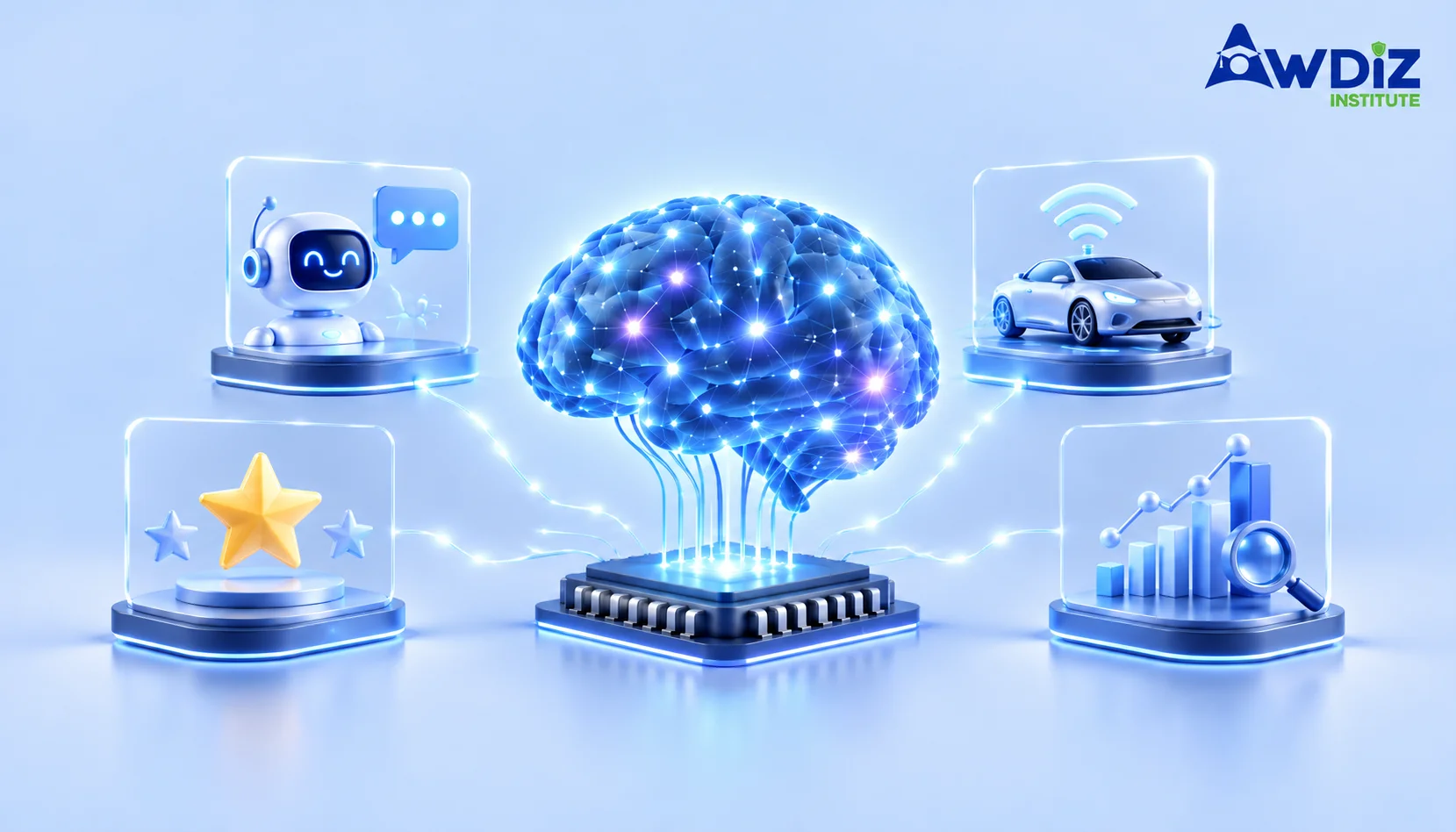
Artificial Intelligence is not one single technology. Different AI systems can recognize patterns, follow reasoning rules, predict outcomes, create new content or take actions within a defined workflow. When people discuss the types of Artificial Intelligence, they often mix up several classification methods. The clearest approach is to separate AI by capability, technical method and application.
Understanding these distinctions helps beginners avoid common misconceptions—for example, believing that a chatbot must have human-level intelligence simply because it can answer many questions.
Types of AI Based on Capability
1. Narrow Artificial Intelligence (ANI)
Narrow AI refers to systems developed to handle defined tasks or families of tasks. Examples include image recognition, product recommendations, speech transcription and fraud detection. Many modern assistants can perform a wide range of useful tasks, but their performance does not establish that they possess general human-level intelligence.
Narrow AI is the category that best describes practical AI applications used today. Its strengths are usually evaluated in specific contexts, using measures such as accuracy, usefulness, latency and safety.
2. Artificial General Intelligence (AGI)
Artificial General Intelligence is a proposed level of AI capability in which a system could learn and perform a very broad range of intellectual tasks with the flexibility associated with general intelligence. There is no universally agreed test that establishes exactly when AGI has been achieved, and its definition remains debated.
AGI is therefore better treated as a research concept and an area of discussion than as a confirmed category of ordinary commercial software.
3. Artificial Superintelligence (ASI)
Artificial Superintelligence describes a hypothetical system that would exceed human capability across a very broad range of intellectual tasks. It is a speculative concept, not a demonstrated product category. Discussions about ASI often focus on safety, control and long-term societal consequences rather than everyday tools.
Other Ways People Classify AI
Some educational materials describe reactive machines, limited-memory systems, theory-of-mind AI and self-aware AI. These labels come from a conceptual framework about system behavior. They are not the same as a list of well-established commercial technologies. Theory-of-mind and self-aware AI, in particular, should not be presented as confirmed deployed capabilities.
A simpler modern approach is to classify AI by how it produces results and what task it performs.
Types of AI Based on Technology
Rule-Based AI
Rule-based systems use knowledge and explicit logic to arrive at decisions. They can be understandable and predictable when rules are clear. However, complex or changing situations can make large rule sets difficult to maintain. Such systems are important to AI history and remain useful in some narrow domains.
Machine Learning AI
Machine learning models learn statistical patterns from examples. They can support classification, prediction and recommendation tasks. Their reliability depends heavily on how the training data is prepared and how results are evaluated on unfamiliar examples.
Deep Learning AI
Deep learning is a branch of machine learning based on neural networks with multiple layers. It is useful for tasks involving complex patterns in language, images, audio and other data. Deep learning often needs more data and computing resources than simpler approaches, though practical requirements vary widely.
Generative AI
Generative AI creates new text, images, code, sound or other outputs from prompts or input data. A writing assistant and an image-generation system are examples. Generated content can be useful, but it still requires evaluation for factual accuracy, originality, privacy and suitability.
AI Agents and Tool-Using Systems
An AI agent is commonly used to describe a system that can carry out multistep work toward a goal, sometimes by using external tools. The term has several definitions. In practice, reliable agents require controlled permissions, checks on tool use and a way for people to review high-impact actions.
Comparison Table: AI Types at a Glance
| Type | Meaning | Example or status |
|---|---|---|
| Narrow AI | Performs specific tasks | Image classification, recommendations |
| AGI | Proposed broad general intelligence | Research concept, definition debated |
| ASI | Hypothetical intelligence beyond human capabilities | Speculative concept |
| Rule-based AI | Uses explicitly defined knowledge and rules | Expert decision rules |
| Machine learning | Learns patterns from data | Spam prediction |
| Deep learning | Uses multilayer neural networks | Speech and image models |
| Generative AI | Produces content | Writing or image tools |
Which Type of AI Should Beginners Learn First?
Beginners should not start by trying to build AGI. Start with concrete goals. If you want to understand how AI makes predictions, study simple machine learning examples. If you enjoy writing and creative workflows, learn how to use and evaluate generative AI tools. If you want to create production applications, build programming fundamentals and learn how models are integrated with software.
The AI Course for Beginners guide provides a practical progression. You can also read How Does Artificial Intelligence Work? to understand how models are trained and used.
Why This Classification Matters
Different types of AI create different expectations. A recommendation model should be evaluated by how relevant its suggestions are. A generated answer should be checked for accuracy. A tool-using agent requires permission limits and failure handling. Describing these systems simply as “intelligent” hides the practical details needed to use them responsibly.
Conclusion: The types of Artificial Intelligence can be understood through several useful lenses: capability, method and application. Narrow AI describes most practical systems; AGI and ASI remain conceptual categories. Rule-based AI, machine learning, deep learning and generative AI explain different technological approaches. Keeping these categories separate makes AI easier to learn and discuss accurately.
Further reading: IBM: Artificial Intelligence
Frequently Asked Questions
Practical systems designed for defined tasks—often called narrow AI—are the most established category.
No. Generative AI describes systems that produce content; AGI refers to a debated idea about broad general intelligence. They classify different things.
There is no accepted demonstration that current commercial AI systems possess human-like self-awareness. Claims about AI consciousness are contested and should be treated carefully.