Bandra - Mumbai, Vashi - Navi Mumbai, Pune, Bangalore, Hyderabad
 ChatGPT
 Perplexity
 Claude

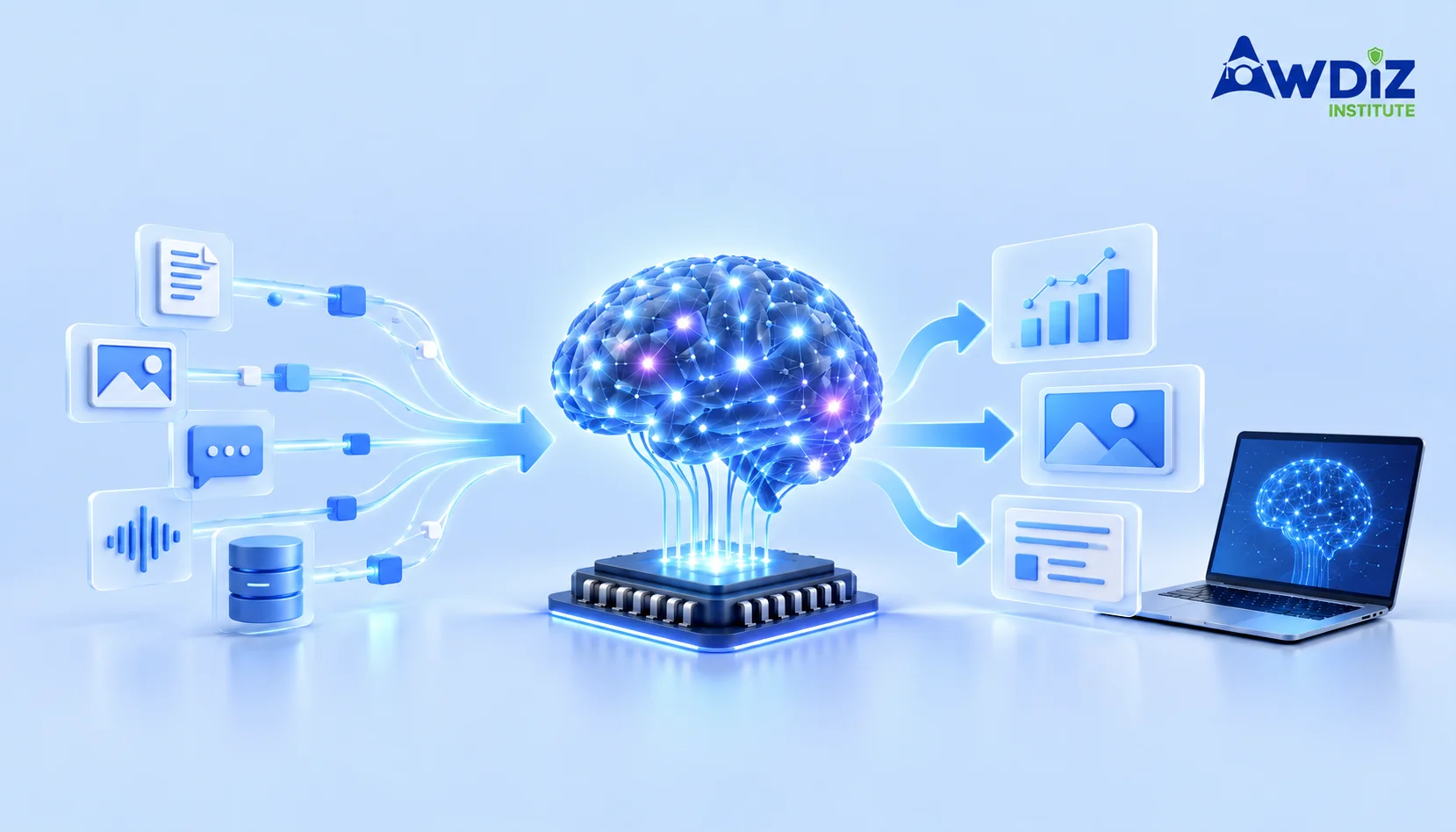
Artificial Intelligence works by using computer systems to process information and produce results such as a prediction, classification, recommendation or generated response. Different AI systems work in different ways. Some use rules and search methods; many modern systems use machine learning models trained on data to recognize patterns that help them respond to new inputs.
You do not need advanced mathematics to understand the basic process. Think of it as an organized sequence: define the task, prepare the information, build or select a model, test the result, and improve the system when needed.
How AI Works: A Simple Step-by-Step Explanation
Step 1: Define the Problem
Every useful AI project needs a specific purpose. Examples include identifying unwanted emails, predicting product demand, recognizing an object in a photo or answering questions from an approved document. A vague goal such as “make an intelligent app” is not enough; the team must decide what successful output looks like.
Step 2: Collect and Prepare Data
Machine learning projects often use examples connected to the task. A spam classifier may require labeled messages showing which are unwanted. Data preparation can include removing duplicates, correcting formatting, checking labels and making sure the examples represent realistic situations. Privacy rules and permission to use the data matter too.
Step 3: Choose a Model
A model is a mathematical or computational system that produces an output from an input. Developers may select a simple classifier for a narrow task or a larger neural network for complex images or language. The choice should depend on accuracy needs, computing resources, available data and how easily the result must be explained.
Step 4: Train the Model
During training, a learning algorithm adjusts model parameters using examples. In supervised learning, the model's prediction is compared with a known correct label or value, and the difference guides improvements. Training does not mean the model memorizes perfect answers; the aim is to learn patterns that can generalize to new cases.
Step 5: Test with Unseen Examples
Testing checks how well the model works on data it did not use during training. A model that looks excellent on familiar examples but fails on new ones may be overfitting. Evaluation must use suitable measures: accuracy alone can be misleading if one class is rare. Depending on the task, developers may inspect precision, recall, error rates and human feedback.
Step 6: Use the Model for Predictions
Once the model is ready, a new input is sent to it. This stage is often called inference. For example, a message arrives, the spam classifier estimates its category, and the email system decides whether to show it in the inbox or spam folder. The final software often includes non-AI rules around the model's output.
Step 7: Monitor and Improve
Real-world data changes. A model may become less useful when new patterns appear, users behave differently or the underlying process changes. Teams monitor performance, investigate errors and update the system when justified. This ongoing work is part of building reliable AI—not an optional extra.
Example: How an AI Spam Filter Works
Imagine a mailbox with 10,000 historical messages labeled spam or not spam. A team uses part of these examples to train a model and keeps separate examples for evaluation. The model may learn patterns from words, sending behavior and message structure. When a new email arrives, it predicts the likelihood that the email is spam.
The system can then use a threshold to decide whether the message should be flagged. If the threshold is too strict, useful messages may be hidden. If it is too relaxed, more spam reaches the inbox. This illustrates why evaluation involves trade-offs and user experience—not just producing a number.
How Does Generative AI Work?
Generative AI differs from a simple spam classifier because it creates content rather than choosing between a few fixed labels. Large language models are trained on large amounts of text and learn statistical relationships among tokens, which are pieces of text. When given a prompt, a language model predicts a sequence of likely next tokens using the prompt and its learned parameters.
This mechanism can produce natural, helpful language without ensuring every statement is correct. Some applications improve usefulness by connecting models to search, approved documents, tools or structured checks. Even then, important responses should be evaluated.
What Are the Main Ways AI Learns?
- Supervised learning uses labeled examples to predict a known outcome.
- Unsupervised learning looks for structure or patterns without the same type of labeled targets.
- Reinforcement learning uses feedback and rewards to help an agent improve its behavior in an environment.
Some modern systems combine multiple methods; these are learning approaches rather than rigid categories covering all AI.
Does Every AI Tool Need to Be Trained from Scratch?
No. Building a new model from the ground up can require substantial data, computing power and expertise. Many products use an existing model through an API, adapt it with suitable data or combine it with a search system. For beginners, creating a small application using an existing model can be a practical way to learn the complete workflow.
Conclusion: AI works best when the goal is clear, the data is suitable, the system is properly evaluated and its outputs are monitored. Learning this process gives you a better foundation than memorizing tool names. Next, explore the Types of Artificial Intelligence or review a beginner AI learning path.
Further reading: Google: Supervised Learning · Google: Machine Learning Crash Course
Frequently Asked Questions
No. Accuracy depends on the task, data, model, evaluation and operating conditions. Generative systems can also produce incorrect text that sounds convincing.
Training adjusts a model using examples or feedback. Inference uses a trained model to produce an output for a new input.
You can understand the workflow without advanced mathematics. Building and optimizing many machine learning systems eventually requires statistics, algebra and other quantitative skills.